
Sunday, October 25, 2026 / by Viktor Boraczuk
Calgary Neighbourhood Demographics & Population (2026)
Calgary Neighbourhood Demographics in 2026: Population, Diversity & Where People Live
Calgary has changed considerably over the past decade. Population growth, international immigration, interprovincial migration, and new residential development have helped transform the city into one of Canada’s major metropolitan centres.
But Calgary isn’t one uniform city.
The demographic characteristics of an established inner-city neighbourhood can look considerably different from those of a newer suburban community. Some areas have younger populations, others have a greater proportion of older residents, and Calgary’s cultural and linguistic diversity varies throughout the city.
For anyone considering moving to Calgary, understanding these differences provides valuable context beyond home prices and property listings.
Using information from the City of Calgary’s community profiles, Statistics Canada’s 2021 Census, and municipal population forecasts, we’ll explore Calgary’s population, age distribution, cultural diversity, housing characteristics, and how its neighbourhoods compare.
Whether you’re relocating from another province, purchasing your first home, or exploring a different part of Calgary, this guide provides a closer look at the people and communities that make up the city.
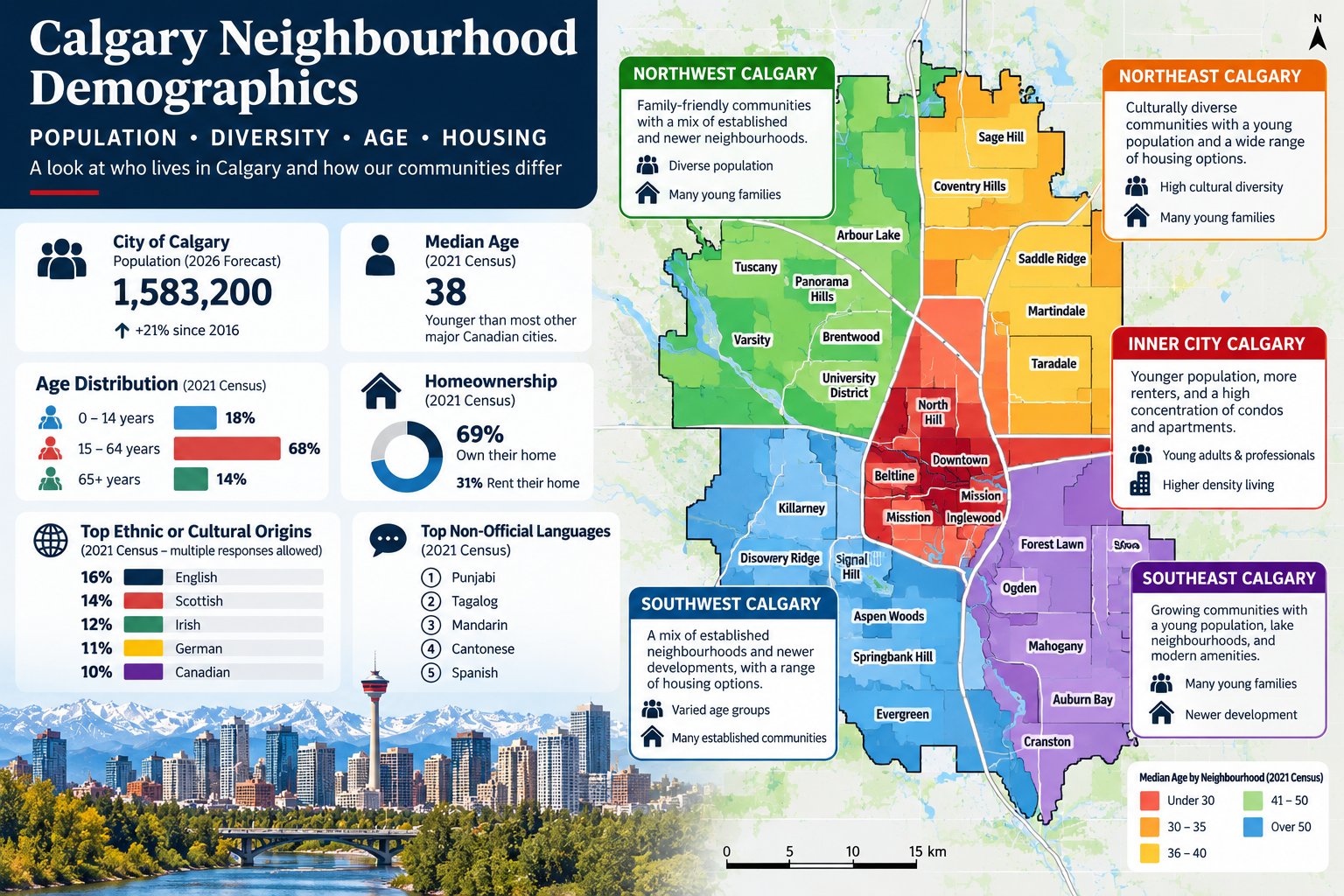
Calgary’s Population in 2026: How Big Is the City?
Calgary has experienced substantial population growth in recent years.
According to Statistics Canada’s 2021 Census, the City of Calgary had a population of 1,306,780 residents, representing a 5.5% increase from 2016.
Since then, Calgary has continued growing.
The City of Calgary’s Spring 2026 Economic Outlook estimated the city’s population at approximately 1,558,700 in April 2025 and forecast approximately 1,583,200 residents for April 2026.
That represents projected growth of roughly 276,000 residents compared with the 2021 Census population, although the figures come from different measurement methods and reference dates.
Calgary Population: Historical and Forecast Figures
|
Year |
Calgary Population |
Source |
|---|---|---|
|
2016 |
1,239,220 |
Statistics Canada Census |
|
2021 |
1,306,780 |
Statistics Canada Census |
|
2025 |
1,558,700 |
City of Calgary estimate |
|
2026 |
1,583,200 |
City of Calgary forecast |
|
2027 |
1,608,700 |
City of Calgary forecast |
|
2030 |
1,689,400 |
City of Calgary forecast |
Sources: Statistics Canada, 2016 and 2021 Census; City of Calgary, Spring 2026 Economic Outlook. Forecast figures are projections, not confirmed Census counts.
Population growth has implications for Calgary’s housing market.
More residents generally mean additional demand for housing, transportation, schools, recreational facilities, and neighbourhood services.
However, the relationship between population growth and real estate prices is not straightforward. Housing construction, interest rates, employment conditions, and the availability of homes also influence market conditions.
How Old Is Calgary’s Population?
One of Calgary’s defining demographic characteristics is its relatively young population compared with several other major Canadian cities.
According to the 2021 Census, Calgary’s median age was approximately 38 years.
This was lower than the median age reported for Toronto, Vancouver, Montreal, Ottawa, Winnipeg, and Halifax.
However, Calgary’s population is not uniformly young.
Age demographics vary considerably between neighbourhoods, reflecting differences in housing types, development history, household composition, and residential mobility.
Calgary Population by Age Group
The 2021 Census provides the following breakdown:
|
Age Group |
Population |
Share of Population |
|---|---|---|
|
Children aged 0–14 |
235,855 |
18.0% |
|
Residents aged 15–64 |
893,525 |
68.4% |
|
Seniors aged 65+ |
177,405 |
13.6% |
|
Total |
1,306,780 |
100% |
Approximately 18% of Calgary’s population was under 15 years old, while roughly 14% was aged 65 or older.
The largest share consisted of residents between 15 and 64.
Calgary’s Aging Population
Although Calgary has a relatively young median age, its senior population has been growing.
Between 2016 and 2021, the number of Calgarians aged 65 and older increased from approximately 138,405 to 177,405.
That’s an increase of approximately 28% in just five years.
The City of Calgary’s 2026 economic forecast projects approximately 218,300 residents aged 65 and older in 2026. This demographic shift has implications for housing demand.
As Calgary’s population ages, accessibility, maintenance requirements, proximity to services, and alternative housing arrangements may become increasingly important considerations.
Bungalows, apartments, condominiums, and other housing types offering fewer stairs or reduced exterior maintenance can provide options for buyers with different accessibility preferences.
Which Calgary Neighbourhoods Have Younger Populations?
Age demographics can vary significantly between communities.
According to the City of Calgary’s analysis of the 2021 Census, areas with some of the lowest median ages included locations near downtown, the University of Calgary, and newer residential communities in Calgary’s northeast, north, and south.
These patterns reflect several different residential environments.
Inner-City Communities
Neighbourhoods such as the Beltline, Downtown West End, Mission, and Sunalta contain substantial concentrations of apartments and condominiums.
These housing types provide options for students, professionals, couples, smaller households, and residents who prefer an urban lifestyle.
Proximity to employment centres, public transportation, restaurants, and entertainment can also influence housing choices.
However, neighbourhood-level age statistics should be reviewed individually rather than assuming all inner-city communities have similar populations.
University-Area Communities
Neighbourhoods surrounding the University of Calgary, including University Heights, Banff Trail, and Brentwood, have residential characteristics influenced partly by their proximity to educational institutions.
The surrounding housing stock includes detached homes, apartments, and other rental accommodation. These areas can attract a variety of residents, including students, university employees, and established households.
Newer Suburban Communities
Newer residential areas throughout Calgary’s north, northeast, south, and southeast can also have younger demographic profiles.
Communities such as Livingston, Carrington, Seton, Legacy, and Belmont have experienced residential development in recent years.
Their housing options include detached homes, duplexes, townhomes, and condominiums. However, the age composition of each community depends on its actual residents, and newer development does not automatically mean a younger population.
Which Calgary Neighbourhoods Have Older Populations?
Calgary’s established communities can have very different age profiles from newer developments.
According to the City’s 2021 Census analysis, a census tract south of the Glenmore Reservoir had a median age of approximately 60 years, among the highest reported in Calgary.
This illustrates how substantially age demographics can vary within the same city.
Several factors can contribute to an older population profile, including long-term homeownership, residential stability, housing types, and the availability of services.
For buyers interested in established communities, neighbourhoods such as Lakeview, Haysboro, Acadia, Willow Park, and Chinook Park offer examples of areas with longstanding residential development.
However, these communities should not automatically be classified as having older populations without reviewing their individual Census profiles.
Age demographics are best understood alongside housing characteristics, property turnover, and neighbourhood development patterns.
How Culturally Diverse Is Calgary?
Calgary is home to residents representing numerous cultural backgrounds, languages, and national origins. International immigration has played an important role in shaping the city’s population.
According to the City of Calgary’s 2021 Census analysis, approximately 53% of residents reported a European ethnic or cultural origin, while approximately 10% reported Canadian origin.
These figures are not mutually exclusive because Census respondents can report more than one ethnic or cultural origin.
Calgary’s Most Commonly Reported Ethnic or Cultural Origins
|
Ethnic or Cultural Origin |
Residents Reporting Origin |
Share |
|---|---|---|
|
English |
205,980 |
16% |
|
Scottish |
177,490 |
14% |
|
Irish |
153,865 |
12% |
|
German |
146,970 |
11% |
|
Canadian |
125,490 |
10% |
Source: City of Calgary analysis of the 2021 Census. Respondents could report multiple origins, so percentages should not be added together.
These are the five most frequently reported individual ethnic or cultural origins in the City’s published summary.
They do not represent Calgary’s complete demographic composition.
Calgary is also home to substantial South Asian, Chinese, Filipino, Black, Arab, Indigenous, and other communities.
It’s important to distinguish between ethnic or cultural origin, immigration status, and the Census concept of racialized population groups, as each measures something different.
How Does Cultural Diversity Vary Across Calgary?
Calgary’s cultural diversity is not distributed evenly across its neighbourhoods.
The City’s ward profiles provide insight into how demographic characteristics vary geographically.
An independently prepared analysis of the 2021 ward profiles identified the following areas as having particularly high proportions of selected population groups.
Examples of Calgary’s Cultural Diversity by Ward
|
Population Group |
Ward |
Reported Share |
|---|---|---|
|
South Asian |
Ward 5 |
54% |
|
Chinese |
Ward 3 |
18% |
|
Filipino |
Ward 13 |
13% |
|
Black |
Ward 10 |
11% |
|
Arab |
Ward 10 |
9% |
|
Indigenous |
Ward 9 |
6% |
Source: Community-created analysis of City of Calgary ward profiles based on 2021 Census information. These figures are historical, independently compiled, and should be verified against the City’s original ward profiles before being treated as definitive statistics.
These figures demonstrate how demographic composition can vary across different parts of Calgary.
However, municipal wards contain numerous neighbourhoods, and ward-level statistics should not be interpreted as describing every community within a ward.
Likewise, the proportion of any individual population group is not a complete measure of a neighbourhood’s diversity.
A more comprehensive assessment would consider the distribution of multiple population groups, languages, immigration backgrounds, and other demographic characteristics.
Northeast Calgary
Northeast Calgary includes established residential communities such as Saddle Ridge, Martindale, Taradale, Falconridge, and Castleridge, alongside newer developments.
The area contains numerous businesses, restaurants, grocery stores, cultural organizations, and community services.
Different neighbourhoods have distinct housing characteristics, development histories, and demographic profiles.
For someone researching northeast Calgary, reviewing individual community profiles provides more useful information than treating the entire quadrant as one demographic area.
Northwest Calgary
Northwest Calgary includes communities such as Panorama Hills, Coventry Hills, Tuscany, Arbour Lake, Brentwood, and Varsity.
These neighbourhoods vary considerably in age, housing stock, and residential development.
The northwest includes established residential areas, university-adjacent communities, and newer suburban developments.
This creates a wide range of housing options and neighbourhood characteristics.
Southwest Calgary
Southwest Calgary contains some of the city’s oldest residential neighbourhoods alongside newer communities.
Areas such as Mount Royal, Bankview, Mission, Aspen Woods, West Springs, Evergreen, and Silverado differ substantially in housing types, population density, and development history.
Buyers can find everything from inner-city apartments and townhomes to detached estate properties.
Southeast Calgary
Southeast Calgary includes established communities such as Acadia, Willow Park, and McKenzie Lake, along with newer developments including Mahogany, Auburn Bay, Seton, and Legacy.
The southeast also contains significant commercial, employment, and recreational areas.
As with other quadrants, community-level demographics provide a more accurate picture than broad geographic generalizations.
What Languages Are Spoken in Calgary?
Calgary’s linguistic diversity is another reflection of its multicultural population.
While English is the most widely used language, residents speak numerous other languages at home.
According to the City’s analysis of the 2021 Census, the ten most common non-official languages spoken most often at home were:
|
Rank |
Language |
|---|---|
|
1 |
Punjabi |
|
2 |
Tagalog |
|
3 |
Mandarin |
|
4 |
Cantonese |
|
5 |
Spanish |
|
6 |
Arabic |
|
7 |
Urdu |
|
8 |
Vietnamese |
|
9 |
Korean |
|
10 |
Russian |
Source: City of Calgary, 2021 Census population profile.
Language patterns have also changed over time.
For example, Mandarin moved ahead of Cantonese between the 2016 and 2021 rankings, while Korean and Russian appeared among the ten most common non-official home languages in 2021.
These figures reflect languages spoken most often at home, not necessarily all languages residents know or use.
For newcomers, Calgary’s linguistic diversity can be reflected in community organizations, businesses, restaurants, cultural events, and services offered throughout the city.
Religion and Cultural Communities in Calgary
Calgary’s religious composition also reflects a wide range of backgrounds and beliefs.
The 2021 Census recorded the following religious affiliations:
|
Religious Affiliation |
Residents |
Approximate Share |
|---|---|---|
|
Christian |
575,250 |
45% |
|
No religion or secular perspectives |
499,375 |
39% |
|
Muslim |
95,925 |
7% |
|
Sikh |
49,465 |
4% |
|
Hindu |
33,450 |
3% |
|
Buddhist |
20,855 |
2% |
|
Jewish |
6,390 |
0.5% |
Source: City of Calgary, 2021 Census population profile. Percentages are rounded, and smaller religious categories are not displayed.
Religious affiliation is one of many demographic characteristics that can be explored through Census information.
It does not determine an individual’s housing preferences or indicate whether a neighbourhood is suitable for any particular resident.
For those interested in specific community services, cultural organizations, or places of worship, researching the actual locations of those amenities is more useful than relying on neighbourhood demographic averages.
Calgary Households: How Do People Live?
Beyond age and cultural background, household composition provides valuable insight into Calgary’s residential landscape. The 2021 Census recorded approximately 502,305 households in Calgary. Of these, approximately 345,690 were owner households, while 156,615 were renter households.
Calgary Homeownership vs. Renting
|
Housing Tenure |
Households |
Approximate Share |
|---|---|---|
|
Owner households |
345,690 |
69% |
|
Renter households |
156,615 |
31% |
|
Total |
502,305 |
100% |
Source: City of Calgary, 2021 Census population profile.
Approximately seven out of ten Calgary households owned their homes in 2021.
Of the owner households, 65.2% had a mortgage.
This provides an interesting snapshot of Calgary’s housing market before the substantial population growth and changing market conditions experienced in subsequent years.
How Housing Tenure Varies by Neighbourhood
Homeownership rates can differ considerably between communities.
Neighbourhoods with large concentrations of rental apartments may have different ownership patterns from predominantly detached-home communities.
However, property type alone does not determine whether a residence is owner-occupied or rented.
A condominium can be owner-occupied, while a detached home can be a rental property.
For buyers evaluating a particular neighbourhood, the City’s community profiles can help identify local ownership and rental patterns.
How Much Do Calgary Households Spend on Housing?
Housing affordability is an important consideration for residents and newcomers.
According to the City’s 2021 Census analysis, median monthly shelter costs were approximately:
- $1,720 for owner-occupied dwellings
- $1,350 for rented dwellings
These are historical Census figures and should not be confused with current Calgary mortgage payments or advertised rental rates.
The figures reflect shelter costs reported at the time of the Census.
For homeowners, shelter costs can include expenses such as mortgage payments, property taxes, utilities, and applicable condominium fees.
For renters, shelter costs can include rent and applicable utility expenses.
Current housing costs depend on property type, neighbourhood, financing conditions, and market availability.
Buyers relocating to Calgary should therefore compare current listings and financing estimates rather than relying on historical Census shelter costs when establishing a budget.
How Calgary’s Neighbourhoods Differ by Housing Type
Calgary’s housing stock varies considerably from one community to another. Understanding these differences can be particularly useful for buyers unfamiliar with the city.
Established Inner-City Neighbourhoods
Communities such as Beltline, Mission, Sunalta, and Lower Mount Royal contain substantial concentrations of apartments and condominiums.
These neighbourhoods can offer convenient access to employment centres, public transportation, restaurants, and other urban amenities.
However, buyers should consider condominium fees, parking arrangements, building maintenance, and available living space.
Established Residential Communities
Neighbourhoods such as Haysboro, Acadia, Brentwood, Willow Park, and Lakeview contain substantial areas of detached residential housing.
Many of these communities were developed decades ago and feature mature streetscapes, established amenities, and varied property conditions.
Depending on the neighbourhood and property, buyers may encounter opportunities for renovation, redevelopment, or purchasing an extensively updated home.
Newer Suburban Communities
Communities such as Mahogany, Auburn Bay, Seton, Legacy, Livingston, and Belmont feature more recent residential development.
Housing options can include detached homes, duplexes, townhomes, and condominiums.
Some developments also incorporate neighbourhood commercial areas, parks, pathways, and recreational amenities.
Newer communities may continue to evolve as additional homes and infrastructure are completed.
Acreage and Rural Properties
For buyers looking beyond Calgary’s municipal boundaries, surrounding areas such as Rocky View County and Foothills County offer additional residential options.
Acreage properties provide a different living environment, with considerations involving land use, water systems, septic systems, property maintenance, and commuting distances.
These rural properties are not included in Calgary’s municipal community profiles unless they fall within the city itself.
Calgary’s Population Growth and the Future of Housing
Calgary’s population growth has important implications for residential development.
The City’s Spring 2026 Economic Outlook forecasts approximately 603,400 households in 2026, compared with an estimated 593,400 in 2025.
The same forecast projects approximately 612,500 households in 2027.
These projections suggest continued household formation and a corresponding need for housing.
However, population and household growth do not translate directly into predictable property-price increases.
The Calgary housing market is influenced by multiple factors, including:
- The number of homes available for sale.
- New housing construction and development activity.
- Mortgage rates and financing conditions.
- Employment and economic growth.
- Migration patterns.
- Housing preferences and affordability.
For prospective buyers, understanding Calgary’s broader demographic trends can provide useful context, but individual purchasing decisions should still be based on current market conditions and property-specific considerations.
How to Research Calgary Neighbourhood Demographics
One of the most useful resources for anyone researching Calgary communities is the City of Calgary’s Community Profiles database.
The City publishes detailed demographic information for individual neighbourhoods based on Statistics Canada’s Census.
The profiles include information on:
Population and age: Total population, age distribution, and other demographic characteristics.
Families and households: Household composition, family characteristics, and living arrangements.
Languages: Languages spoken at home and knowledge of official languages.
Immigration and population diversity: Immigration characteristics and other Census measures of population diversity.
Education and employment: Educational attainment, labour-force participation, and employment characteristics.
Income: Household and individual income information.
Housing: Dwelling characteristics, housing tenure, shelter costs, and residential mobility.
Transportation: Commuting patterns and methods of transportation to work.
Where to Find Calgary Community Profiles
Visit the City of Calgary’s Community Profiles webpage and select the neighbourhood you’re interested in researching. Each community profile provides a detailed breakdown of Census information.
For readers comparing multiple neighbourhoods, I recommend reviewing the same indicators across each profile. For example, you might compare median age, housing tenure, household size, dwelling types, and commuting patterns.
It’s also important to remember that the profiles are based on the 2021 Census.
Communities that have experienced substantial development since 2021 may have changed considerably.
What Should Homebuyers Look for Beyond Demographics?
Demographic statistics can provide valuable context, but they don’t tell the entire story of a neighbourhood. When comparing Calgary communities, buyers should also consider practical factors such as:
Current housing prices: Review recent comparable sales and active listings for the property types you’re considering.
Schools and educational facilities: Confirm school designations, programs, and enrollment information directly with the relevant school boards.
Transportation: Evaluate commuting distances, transit routes, road access, and travel times.
Parks and recreation: Research pathways, recreation centres, parks, and community amenities.
Neighbourhood development: Consider whether nearby land is undergoing development or redevelopment.
Property characteristics: Compare home age, condition, lot size, maintenance requirements, and potential future expenses.
Ultimately, the most suitable neighbourhood is the one that aligns with your housing requirements, budget, and everyday needs.
Frequently Asked Questions About Calgary Demographics
What is Calgary’s population in 2026?
The City of Calgary’s Spring 2026 Economic Outlook forecasts approximately 1,583,200 residents for April 2026. This is a municipal population projection rather than a confirmed 2026 Census count.
What is the average age in Calgary?
According to the 2021 Census, Calgary’s median age was approximately 38 years. The City’s 2026 economic forecast projects an average age of approximately 38.1 years. Median age and average age are different statistical measures and should not be compared as though they are interchangeable.
Is Calgary a culturally diverse city?
Yes. Calgary is home to residents representing numerous ethnic, cultural, linguistic, and religious backgrounds. The 2021 Census identifies substantial diversity in reported ethnic origins, languages spoken at home, and religious affiliations.
Which Calgary neighbourhoods have younger populations?
The City’s 2021 Census analysis identifies areas near downtown, the University of Calgary, and newer communities in the north, northeast, and south as having some of Calgary’s lowest median ages. However, individual neighbourhood statistics should be reviewed to make specific comparisons.
What percentage of Calgary residents own their homes?
Approximately 69% of Calgary households were owner-occupied in 2021, according to the Census. This is a historical figure and does not necessarily represent the current homeownership rate.
Where can I find Calgary neighbourhood population statistics?
The City of Calgary publishes community profiles containing population, household, age, language, immigration, income, housing, and employment information. These profiles provide a useful starting point for researching individual Calgary communities.
Final Thoughts: Understanding Calgary’s Communities
Calgary’s neighbourhoods are as varied as the people who live in them.
From established inner-city communities to newer suburban developments, each area offers a different combination of housing options, amenities, transportation access, and residential characteristics. The City’s demographic information helps illustrate these differences.
Calgary has a relatively young population compared with several other major Canadian cities, a growing senior population, and substantial cultural and linguistic diversity.
Its housing landscape also continues to evolve as the city accommodates additional residents and households. For anyone considering a move to Calgary, neighbourhood research should extend beyond property prices. Understanding the available housing, transportation options, amenities, and broader community characteristics can help buyers make more informed decisions.
Thinking About Moving to Calgary?
Whether you’re relocating from Vancouver, Toronto, elsewhere in Alberta, or moving between Calgary communities, choosing the right neighbourhood is an important part of finding the right home.
I’ve been helping buyers and sellers navigate Calgary’s real estate market since 2016, working with residential properties, acreages, and investment properties throughout Calgary and the surrounding communities.
If you’re exploring Calgary neighbourhoods, I can help you compare current housing prices, review available properties, and better understand the differences between communities.
Explore Calgary homes for sale, browse our Calgary Community Guide, or contact me directly to discuss your next move.
Viktor Boraczuk
REALTOR® | REAL Broker
Calgary House Guide
CalgaryHouseGuide.com
Data Sources and Methodology
This article draws on the following sources:
- City of Calgary — Community Profiles: Neighbourhood-level demographic information based on the 2021 Census of Canada.
- City of Calgary — Calgary Population Profile: Citywide population, age, cultural origin, language, religion, and housing statistics.
- Statistics Canada — 2021 Census of Population: Official Census population and demographic information.
- City of Calgary — Spring 2026 Calgary and Region Economic Outlook: Municipal population and household estimates and forecasts.
- City of Calgary — Ward Profiles: Ward-level demographic information from the 2021 Census.
Community-level demographic figures generally reflect the 2021 Census, while 2025–2027 population figures are municipal estimates or forecasts. These sources have different reference dates and methodologies.
The demographic information is intended to provide general context about Calgary and its communities. It should not be used to infer the characteristics of individual residents or determine whether a particular person belongs in a neighbourhood.