Sunday, October 25, 2026 / by Viktor Boraczuk
Calgary’s Most Densely Populated Neighbourhoods (2026)
Calgary’s Most Densely Populated Neighbourhoods in 2026: Where People Live & Why It Matters
Calgary is known for its expansive suburban communities, established inner-city neighbourhoods, and growing collection of residential developments. But have you ever wondered which Calgary neighbourhoods have the most people living within the smallest geographic area?
While communities such as the Beltline, Downtown West End, and Lower Mount Royal are known for their apartment buildings and urban lifestyles, other parts of Calgary offer considerably more space between homes, larger residential lots, and lower-density housing.
Understanding these differences can be surprisingly useful when deciding where to buy a home.
Population density can influence everything from housing styles and neighbourhood amenities to transportation options, walkability, and the overall character of a community.
Using information from the 2026 YYC-Wander Calgary Neighbourhood Density Dashboard, we’ll explore how Calgary’s communities compare, which neighbourhoods have the highest reported population density, and what these statistics mean for prospective homebuyers.
Whether you’re relocating to Calgary, purchasing your first home, or considering a move to a different part of the city, understanding neighbourhood density provides another perspective on Calgary’s residential landscape.
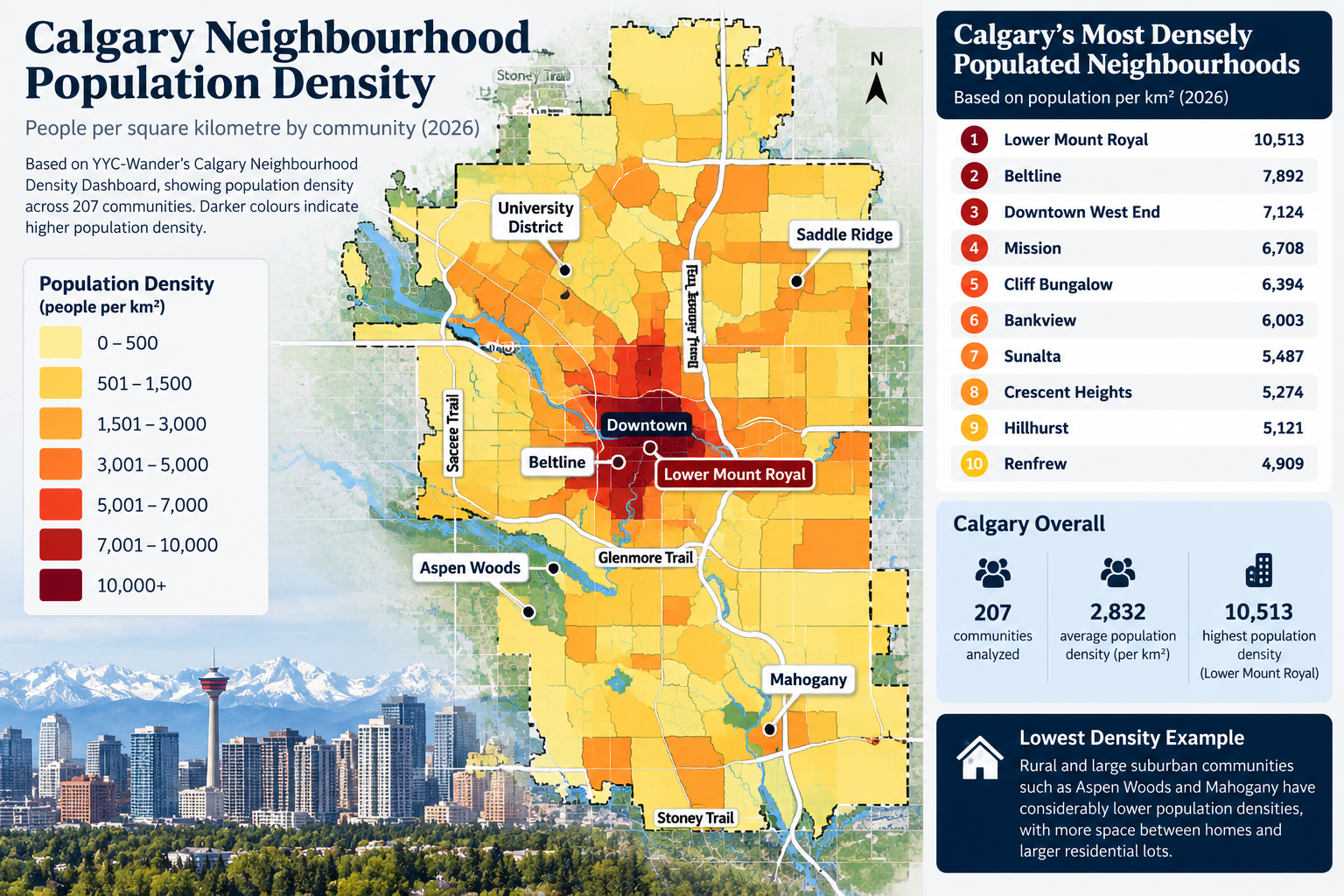
Calgary Population Density in 2026: An Overview
Calgary is geographically expansive, with neighbourhoods that vary significantly in their residential development patterns.
Some communities contain thousands of residents living in apartment buildings and condominium developments, while others consist primarily of detached homes on larger residential lots.
According to the YYC-Wander Calgary Neighbourhood Density Dashboard, the following figures were reported in its 2026 community comparison:
|
Calgary Population Density Statistics |
Reported Figure |
|---|---|
|
Communities analyzed |
207 |
|
Average population density across displayed communities |
2,832 people/km² |
|
Highest reported population density |
Lower Mount Royal |
|
Lower Mount Royal population density |
10,513 people/km² |
|
Highest reported housing density |
Lower Mount Royal |
|
Lower Mount Royal residential property density |
7,068 properties/km² |
Source: YYC-Wander, Calgary Neighbourhood Density Dashboard, 2026. Figures reflect the dashboard’s displayed community selection and should not be interpreted as a citywide population-weighted average.
These figures illustrate the substantial differences between Calgary’s neighbourhoods.
Lower Mount Royal, for example, has a reported population density approximately 3.7 times the average shown across the 207 communities.
However, population density doesn’t necessarily tell us how many people live in a neighbourhood overall.
A large suburban community can have considerably more residents than a small inner-city neighbourhood while maintaining a lower population density.
Understanding that distinction is important when comparing different areas of Calgary.
What Is Population Density?
Population density measures the number of people living within a defined geographic area. It is generally expressed as the number of residents per square kilometre. For example, consider two hypothetical Calgary neighbourhoods.
Community A has 10,000 residents spread across five square kilometres.
Community B has 8,000 residents living within one square kilometre.
Although Community A has more residents overall, Community B is considerably more densely populated.
|
Example |
Population |
Land Area |
Population Density |
|---|---|---|---|
|
Community A |
10,000 |
5 km² |
2,000 people/km² |
|
Community B |
8,000 |
1 km² |
8,000 people/km² |
Illustrative example only.
Population density is particularly useful when comparing established inner-city neighbourhoods with suburban residential developments. However, it doesn’t necessarily measure how crowded a neighbourhood feels.
Parks, road networks, building layouts, commercial developments, and the distribution of residential properties can all influence the experience of living within a community.
Which Calgary Neighbourhood Has the Highest Population Density?
According to the YYC-Wander dashboard, Lower Mount Royal has the highest reported population density among the 207 communities displayed, at approximately 10,513 residents per square kilometre. The community also records the highest residential property density, at approximately 7,068 properties per square kilometre.
These figures reflect Lower Mount Royal’s compact urban environment and substantial concentration of multifamily residential properties.
Located immediately south of Calgary’s Beltline, Lower Mount Royal offers a very different housing environment from the city’s suburban neighbourhoods.
The community features a mixture of condominium buildings, apartment developments, and established residential properties.
Its location provides convenient access to 17th Avenue SW, one of Calgary’s prominent shopping, restaurant, and entertainment corridors.
Residents can also access nearby parks, public transportation, and downtown employment opportunities.
For buyers who prioritize walkability and convenient access to urban amenities, Lower Mount Royal represents an alternative to traditional suburban living.
However, higher residential density can also mean different considerations regarding parking, outdoor space, building amenities, and condominium ownership.
Other Calgary Neighbourhoods Known for Higher-Density Housing
While Lower Mount Royal leads the dashboard’s reported density comparison, several other Calgary neighbourhoods are known for their concentration of apartments, condominiums, and multifamily housing. The following communities are examples of Calgary’s established urban residential areas rather than a verified ranking of the next-highest population densities.
Beltline
The Beltline is one of Calgary’s most recognizable urban residential neighbourhoods. Located immediately south of downtown, the community features numerous condominium towers, apartment buildings, and mixed-use developments.
Its proximity to employment centres, restaurants, shopping, entertainment, and public transportation makes it a popular option for buyers seeking an urban lifestyle.
Housing options range from smaller condominium units to larger luxury residences.
Unlike many suburban communities, the Beltline offers opportunities to live within walking distance of numerous everyday amenities. For buyers considering the area, important factors may include condominium fees, parking availability, building amenities, and proximity to major roads or entertainment districts.
Downtown West End
Downtown West End is another Calgary neighbourhood characterized by a substantial concentration of multifamily residential buildings. Located along the western edge of downtown, the community offers convenient access to the Bow River pathway system, public transportation, and nearby employment centres. Its residential landscape includes high-rise condominiums and apartment developments. For buyers who want to minimize commuting distances or enjoy an urban lifestyle, Downtown West End provides a different residential experience from Calgary’s outer suburban communities.
Mission
Mission is an established inner-city Calgary neighbourhood known for its restaurants, shops, residential developments, and proximity to the Elbow River. The community features a mixture of apartment buildings, condominiums, and older residential properties. Its walkable streets and access to nearby amenities make it attractive to buyers interested in urban living. Mission also demonstrates how residential density can coexist with established streetscapes and recreational opportunities.
Bankview
Bankview is an established southwest Calgary neighbourhood featuring a mixture of older detached homes, apartment buildings, condominiums, and redevelopment properties. Located near 17th Avenue SW and the Beltline, the community provides convenient access to inner-city amenities. Bankview’s varied housing stock creates opportunities for buyers interested in different property types and price points. The community also illustrates how Calgary’s established neighbourhoods can accommodate a combination of lower-density and higher-density residential development.
Sunalta
Sunalta is an established inner-city neighbourhood located west of downtown Calgary. The community features a mixture of apartments, condominiums, townhomes, and detached properties. Its proximity to the Sunalta CTrain station provides convenient access to Calgary’s public transportation network. For buyers interested in inner-city living without necessarily purchasing a high-rise condominium, Sunalta offers a variety of residential options.
Population Density vs. Housing Density: What’s the Difference?
Although population density and housing density are related, they measure different things.
Population density measures the number of residents living within a geographic area.
Housing density measures the number of residential properties or housing units within that area.
A neighbourhood containing numerous small condominium units may have a high housing density without necessarily having an equally high population density.
Conversely, a neighbourhood containing larger households may have a higher population density relative to its number of residential properties.
For example, a condominium building containing 100 units occupied primarily by one or two people may have fewer residents than a development containing 60 larger households.
This distinction is particularly important when comparing Calgary’s inner-city communities with newer suburban developments.
Why Does This Matter for Real Estate?
Housing density can provide insight into the types of properties available within a neighbourhood.
Higher-density communities often feature a greater concentration of condominiums, apartments, and other multifamily developments.
Lower-density communities are more likely to feature detached homes, larger residential lots, and lower-rise residential development.
However, many Calgary neighbourhoods contain a combination of housing types. For buyers, understanding the available housing stock is often more useful than focusing exclusively on population density.
Inner-City Calgary vs. Suburban Calgary: Which Offers a Better Lifestyle?
One of Calgary’s defining characteristics is the contrast between its established inner-city neighbourhoods and newer suburban communities. Both offer advantages, but the residential experience can be quite different.
Inner-City Calgary: Walkability and Urban Convenience
Higher-density inner-city neighbourhoods often provide convenient access to restaurants, shops, entertainment, public transportation, and employment centres.
For residents working downtown, living in an inner-city community may reduce commuting distances.
Some neighbourhoods also offer opportunities to complete everyday errands without relying exclusively on a vehicle.
However, higher-density living can involve trade-offs.
Buyers may encounter smaller living spaces, shared building amenities, condominium fees, and limited private outdoor areas. Parking availability can also vary depending on the property.
Suburban Calgary: Space and Residential Amenities
Calgary’s suburban neighbourhoods generally offer a different residential environment.
Communities such as Tuscany, Mahogany, Auburn Bay, Cranston, Legacy, and Evergreen feature substantial areas of detached housing, along with townhomes and condominium developments.
Many newer suburban communities incorporate parks, pathways, playgrounds, schools, and neighbourhood commercial centres.
For buyers seeking additional bedrooms, private yards, attached garages, or larger homes, suburban Calgary provides numerous options.
However, commuting distances and transportation requirements may differ from those associated with inner-city living.
Comparing Inner-City and Suburban Calgary
|
Consideration |
Higher-Density Inner City |
Lower-Density Suburbs |
|---|---|---|
|
Common housing types |
Condos, apartments, townhomes |
Detached homes, townhomes, condos |
|
Walkability |
Often higher near commercial areas |
Varies by community |
|
Private outdoor space |
Often more limited |
More common with detached homes |
|
Downtown access |
Generally closer |
Often longer commute |
|
Public transportation |
Often more accessible |
Depends on location |
|
Parking |
May be limited or assigned |
Driveways and garages more common |
|
Residential character |
Urban and mixed-use |
Often predominantly residential |
These are general characteristics rather than universal rules.
Calgary contains numerous exceptions, including walkable suburban communities and established inner-city neighbourhoods with larger detached properties.
Does Higher Population Density Mean More Affordable Housing?
Not necessarily.
Although higher-density developments can provide more housing units within a smaller geographic area, population density alone does not determine property prices.
Several factors influence Calgary real estate values, including location, property size, age, condition, amenities, and market demand.
For example, a condominium in a desirable inner-city location may have a lower total purchase price than a large suburban detached home.
However, the condominium could still command a higher price per square foot.
Similarly, a luxury condominium in a premium downtown development may cost considerably more than a detached home in another part of Calgary.
Why Higher-Density Housing Can Offer Different Entry Points
Condominiums and townhomes often provide alternatives for buyers who do not require the space or maintenance responsibilities associated with detached properties.
This can create additional housing options across different price ranges.
However, buyers should consider the total cost of ownership.
Condominium fees, property taxes, insurance, maintenance obligations, and financing costs can all affect monthly expenses.
For this reason, comparing purchase prices alone may not provide an accurate picture of affordability.
Is Calgary Becoming More Densely Populated?
Calgary’s housing landscape continues to evolve as new residential developments are constructed and established neighbourhoods experience redevelopment.
Historically, much of Calgary’s residential growth has occurred through suburban expansion.
However, redevelopment within established neighbourhoods has also introduced additional housing options, including townhomes, rowhouses, secondary suites, and multifamily developments.
These housing types can accommodate more households within existing residential areas.
The pace and location of future development will depend on factors such as population growth, housing demand, infrastructure capacity, land-use regulations, and market conditions.
While the YYC-Wander dashboard provides a useful snapshot of neighbourhood density, determining how much individual communities have changed over time requires comparable historical population and land-area data.
What Does Population Density Mean for Calgary Homebuyers?
When choosing a neighbourhood, population density can provide useful context, but it shouldn’t be the deciding factor.
Instead, buyers should consider how the characteristics associated with different neighbourhoods align with their priorities.
1. Housing Preferences
Do you prefer a detached home with a private yard, or would you rather live in a condominium with less exterior maintenance? Your preferred property type will influence which communities offer the most suitable options.
2. Commuting and Transportation
Living closer to downtown Calgary may reduce commuting distances for some residents. However, buyers working in suburban employment centres may find a home outside the inner city more convenient. Public transportation access should also be evaluated at the individual property level.
3. Walkability and Amenities
Some higher-density neighbourhoods provide convenient access to restaurants, shops, and services. However, density alone does not guarantee walkability. The location of commercial amenities, pedestrian infrastructure, and transportation routes also matters.
4. Parking and Storage
Buyers considering higher-density developments should review parking arrangements, visitor parking, storage availability, and building restrictions. These considerations can be particularly important when comparing condominium ownership with detached housing.
5. Long-Term Housing Needs
A property that suits your current lifestyle may not necessarily meet your needs several years from now. Considering future space requirements, accessibility, and housing preferences can help narrow your search.
Frequently Asked Questions About Calgary Population Density
What is the most densely populated neighbourhood in Calgary?
According to the 2026 YYC-Wander Calgary Neighbourhood Density Dashboard, Lower Mount Royal has the highest reported population density among the 207 communities displayed, at approximately 10,513 residents per square kilometre.
What is Calgary’s average neighbourhood population density?
The YYC-Wander dashboard reports an average of approximately 2,832 residents per square kilometre across the 207 communities included in its displayed comparison. This represents an average of community-level densities rather than a population-weighted density for the entire city.
Is downtown Calgary more densely populated than the suburbs?
Many of Calgary’s inner-city neighbourhoods contain a greater concentration of apartments and condominium buildings than predominantly detached-home suburban communities. However, density varies between individual neighbourhoods, and some newer suburban developments also contain substantial multifamily housing.
Does higher population density mean more traffic?
Not necessarily.
Traffic conditions depend on several factors, including road design, commuting patterns, employment locations, public transportation, and the number of people travelling through an area. A higher-density neighbourhood with strong public transportation and walkable amenities may have different traffic patterns from a lower-density community where residents rely more heavily on vehicles.
Are Calgary’s most densely populated neighbourhoods more affordable?
Not always.
Higher-density housing can provide different purchase-price options, particularly through condominiums and townhomes. However, property values depend on location, building quality, unit size, amenities, and market conditions.
Which Calgary neighbourhoods offer lower-density living?
Many suburban and established residential communities feature substantial areas of detached housing.
Examples include parts of Tuscany, Evergreen, Cranston, Chaparral, and other neighbourhoods throughout Calgary.
However, buyers should review the specific section of a community because housing density can vary significantly within neighbourhood boundaries.
Final Thoughts: Understanding Calgary’s Neighbourhood Density
Calgary offers a wide variety of residential environments, from compact inner-city communities to expansive suburban neighbourhoods. The 2026 YYC-Wander density dashboard highlights these differences, identifying Lower Mount Royal as the highest-density community in its displayed comparison.
However, population density is only one factor to consider when choosing where to live.
For some buyers, a higher-density neighbourhood provides convenient access to employment, restaurants, entertainment, and public transportation.
For others, a lower-density residential community may better accommodate their preferences for additional living space, private outdoor areas, or a different neighbourhood environment.
Neither option is inherently better.
The right choice depends on your budget, housing requirements, commuting needs, and lifestyle preferences.
Understanding Calgary’s neighbourhood characteristics alongside current real estate market conditions can help you make a more informed purchasing decision.
Thinking About Buying or Relocating to Calgary?
Whether you’re moving to Calgary from another province, purchasing your first home, or considering a move within the city, choosing the right neighbourhood is an important part of the process.
I’ve been helping buyers and sellers navigate the Calgary real estate market since 2016, working with residential properties, acreages, and investment properties throughout Calgary and the surrounding communities.
If you’re exploring different areas of Calgary, I can help you compare neighbourhoods, understand current housing prices, and identify properties that align with your needs.
Explore Calgary homes for sale, browse our Calgary Community Guide, or contact me directly to discuss your next move.
Viktor Boraczuk
REALTOR® | REAL Broker
Calgary House Guide
CalgaryHouseGuide.com
Data source: YYC-Wander Calgary Neighbourhood Density Dashboard, 2026. Population and housing density figures reflect the dashboard’s reported community comparison. Readers should consult the original source for methodology, underlying reference dates, and updated figures.