Sunday, October 25, 2026 / by Viktor Boraczuk
Calgary’s Richest Neighbourhoods in 2026 | Income Map
Calgary’s Richest Neighbourhoods in 2026: Average Household Income by Community
Calgary is home to some of Canada’s most desirable residential neighbourhoods, ranging from established inner-city communities with multimillion-dollar estates to newer suburban developments featuring executive homes, expansive green spaces, and family-oriented amenities.
But where do Calgary’s highest-income households actually live?
While communities such as Mount Royal, Elbow Park, Aspen Woods, and Springbank Hill are often associated with luxury real estate, expensive homes don’t necessarily tell the entire story when it comes to household income.
A neighbourhood’s average household income provides another perspective on Calgary’s residential landscape, highlighting differences in demographics, household composition, and economic circumstances across the city.
Using neighbourhood-level income information published by TeploMaps in September 2026, we’ll explore Calgary’s income distribution, the characteristics of its affluent communities, and how household income relates to the local real estate market.
Whether you’re relocating to Calgary, considering a move within the city, or simply curious about how different neighbourhoods compare, understanding these trends can provide useful context when researching where to live.
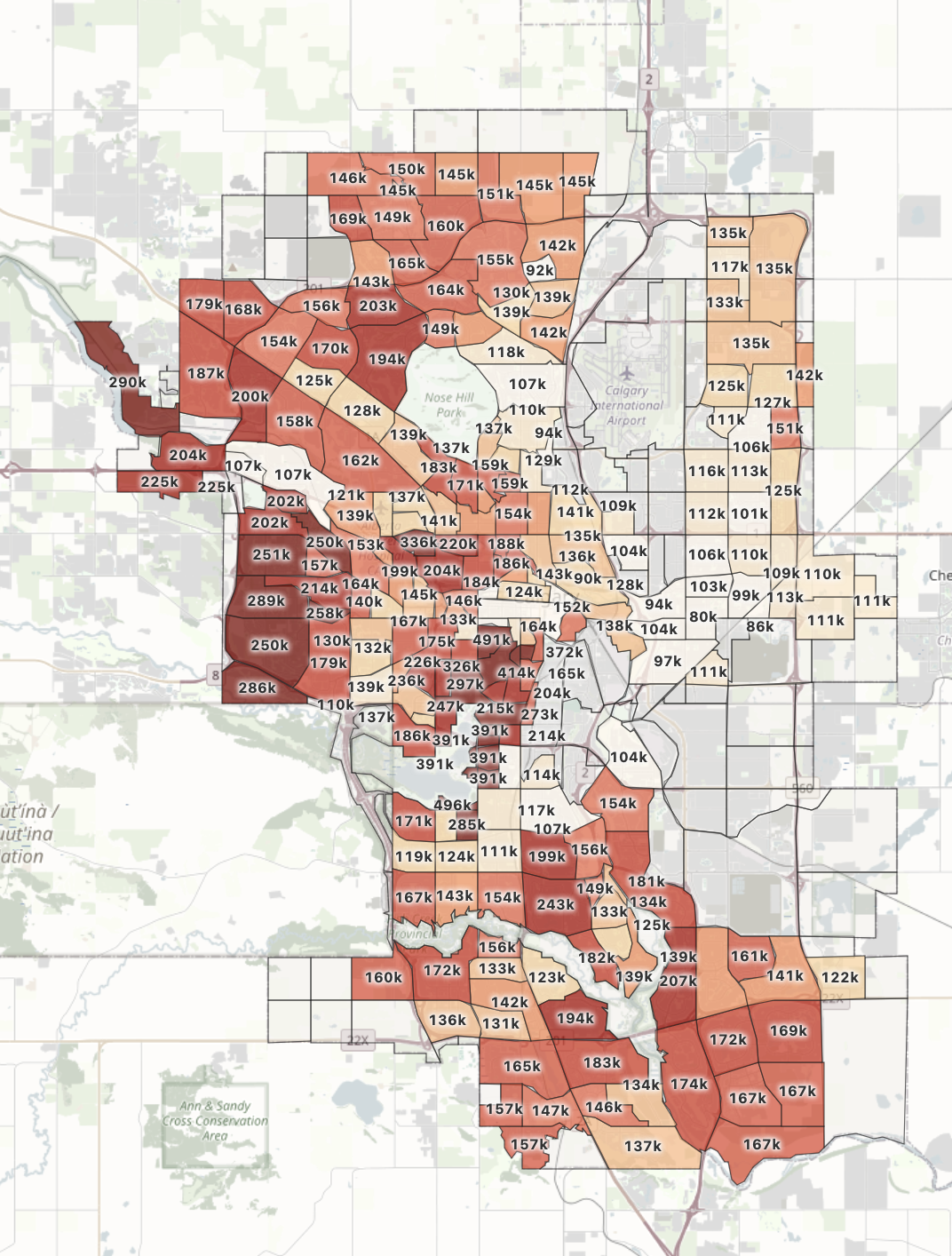
Calgary Household Income by Neighbourhood: 2026 Overview
Calgary’s neighbourhoods vary considerably in average household income.
According to the TeploMaps Calgary Income Map, labelled September 2026, reported average total household incomes range from approximately $80,000 to nearly $500,000 annually across the communities represented.
The map identifies neighbourhood averages reaching approximately $496,000 at the upper end, while other communities report averages closer to $80,000–$110,000.
This represents a substantial difference in reported household income across Calgary.
However, it’s important to understand what these numbers represent.
Average household income is not the same as individual salary, household wealth, or disposable income.
Household income generally includes the combined income of people living within a household. A household with two working professionals, for example, may report considerably more total income than a household with one income earner.
Neighbourhood averages can also be influenced by household size, age distribution, employment patterns, and the presence of particularly high-income households.
For that reason, income statistics should be viewed as one component of a community’s demographic profile rather than a definitive measure of its desirability or affordability.
Source: TeploMaps Calgary Income Map, September 2026. Readers should consult the original map’s methodology and underlying data reference period when interpreting the figures.
Where Are Calgary’s Wealthiest Neighbourhoods Located?
Calgary’s higher-income residential communities are not concentrated in one single area.
Instead, the city offers several distinct types of neighbourhoods commonly associated with affluent households and higher-priced real estate. These range from historic inner-city communities to established western suburbs and newer master-planned developments.
Although the income map provides neighbourhood-level figures, the following communities are discussed as examples of Calgary’s established luxury and executive housing markets rather than as a verified ranking of the city’s highest household incomes.
1. Upper Mount Royal
Upper Mount Royal is one of Calgary’s most recognizable luxury residential communities. Located southwest of downtown, the neighbourhood is known for its historic estates, mature trees, substantial residential lots, and proximity to the city’s central business district.
Unlike newer suburban communities, Upper Mount Royal features an established streetscape with a mixture of architecturally significant homes, extensively renovated properties, and modern custom residences. Its central location offers convenient access to downtown Calgary, the Elbow River, and the restaurants and amenities of nearby 17th Avenue SW.
For buyers seeking prestigious inner-city real estate, Upper Mount Royal remains one of Calgary’s best-known options.
2. Elbow Park
Situated along the Elbow River, Elbow Park is another established Calgary community associated with luxury residential real estate. The neighbourhood features mature landscaping, character homes, renovated properties, and custom-built residences. Its location provides access to river pathways, parks, and nearby communities such as Mission and Britannia.
Elbow Park appeals to buyers who appreciate established neighbourhoods, larger residential lots, and proximity to central Calgary.
As with other inner-city luxury communities, property values can vary considerably depending on lot size, architectural design, renovations, and location.
3. Britannia
Britannia is a relatively small residential community located in southwest Calgary.
Known for its prestigious homes and established surroundings, Britannia offers a combination of privacy, mature landscaping, and convenient access to the Elbow River corridor. The neighbourhood is also close to the Britannia Shopping Plaza and several recreational amenities.
Its limited housing inventory and desirable location contribute to its reputation as one of Calgary’s prominent luxury real estate markets.
4. Aspen Woods
Moving farther west, Aspen Woods represents a different style of upscale Calgary living.
Rather than historic estates and traditional inner-city streetscapes, Aspen Woods features newer executive homes, luxury properties, and planned residential developments. The community offers convenient access to West Calgary amenities, schools, shopping, and major transportation routes.
Aspen Woods is particularly relevant for buyers seeking larger modern homes while maintaining reasonable access to downtown Calgary and the Rocky Mountains.
Its housing options range from townhomes and conventional detached properties to substantial luxury residences.
5. Springbank Hill
Springbank Hill is another established southwest Calgary community offering a wide variety of residential properties. Located along Calgary’s western edge, the neighbourhood includes executive homes, luxury residences, townhomes, and condominium developments.
Some areas feature elevated locations and expansive views, while others provide quieter residential streets and convenient access to nearby amenities.
Springbank Hill’s proximity to major transportation routes, schools, and western Calgary recreational opportunities makes it an attractive option for many buyers.
Because the community contains several distinct housing types and residential developments, income and property values can differ significantly within the neighbourhood itself.
6. West Springs
West Springs has developed into one of Calgary’s prominent west-end residential communities.
The neighbourhood features a mixture of detached homes, executive properties, townhomes, and newer residential developments. Its appeal includes access to shopping, restaurants, schools, and major transportation corridors.
West Springs is an example of how newer suburban communities can offer an upscale residential environment without necessarily resembling Calgary’s traditional inner-city luxury neighbourhoods.
7. Discovery Ridge
Discovery Ridge offers a distinctive residential setting along Calgary’s western edge.
Bordering Griffith Woods Park, the neighbourhood is known for its natural surroundings, wooded pathways, and proximity to recreational areas.
Housing options include detached homes, executive properties, townhomes, and condominiums.
For buyers who prioritize access to natural spaces while remaining within Calgary, Discovery Ridge offers an alternative to more densely developed residential neighbourhoods.
Do Calgary’s Highest-Income Neighbourhoods Also Have the Most Expensive Homes?
Not necessarily.
One of the most interesting distinctions in Calgary real estate is the difference between household income and residential property value. Although the two can be related, they measure very different things.
Household income represents money earned by the people living within a household during a particular period. Property value, meanwhile, reflects what a home may sell for in the current real estate market. Several factors can influence property values independently of neighbourhood income.
Established Wealth vs. Current Household Income
Some of Calgary’s most expensive residential properties are located in established neighbourhoods with a significant number of long-term homeowners. A household that purchased its property decades ago may now own a valuable home despite having a comparatively modest current income.
Retired homeowners, for example, may have accumulated considerable property equity over time while reporting less annual employment income than younger working households. As a result, an expensive neighbourhood does not automatically have the highest average household income.
Dual-Income Households in Newer Communities
Newer suburban communities may contain a greater concentration of households with two working adults. These households can report relatively high combined incomes even when their homes are less expensive than properties in Calgary’s traditional luxury neighbourhoods.
A household earning $250,000 annually and living in a newer detached home may have a higher current income than a retired household living in a multimillion-dollar inner-city property.
This illustrates why income rankings and luxury real estate rankings should not be treated as interchangeable.
Housing Types Influence Neighbourhood Averages
The types of homes available within a community can also influence its household demographics.
Neighbourhoods dominated by larger detached homes may have different household compositions than communities with substantial numbers of apartments, condominiums, or smaller rental properties. However, these patterns are not universal.
Income averages alone cannot establish whether a community is affordable, financially secure, or suitable for a particular buyer.
Calgary’s Highest-Income Communities vs. Its Most Expensive Real Estate
When researching Calgary neighbourhoods, it’s helpful to distinguish between three different measurements.
1. Average Household Income
This measures the average combined income reported by households within a particular area. It provides insight into neighbourhood income characteristics but does not measure accumulated wealth.
2. Average or Benchmark Home Prices
These measures help describe housing market conditions. Average sale prices reflect the properties sold during a particular period, while benchmark prices are designed to represent the price of a typical home within a defined market segment. Neither figure directly measures the income of neighbourhood residents.
3. Household Wealth and Property Equity
Household wealth includes assets such as real estate equity, investments, and savings, less liabilities. A homeowner may have significant accumulated wealth without reporting a particularly high annual income. Understanding these differences is especially important when comparing Calgary’s established luxury communities with its newer executive neighbourhoods.
How Does Household Income Affect Calgary’s Real Estate Market?
Household income is one of several factors that can influence housing demand. Generally speaking, households with greater financial resources may have more flexibility when choosing between housing types, locations, and property features.
However, income is only one part of a buyer’s financial circumstances. Mortgage qualification, existing debt, down payment savings, interest rates, and household expenses all influence purchasing power.
Higher-Income Buyers Often Have More Housing Options
Higher household incomes may provide greater flexibility when considering larger detached homes, newer construction, or properties in premium locations. For some buyers, this may mean prioritizing additional bedrooms, larger lots, home offices, or upgraded finishes. For others, proximity to downtown Calgary, schools, recreational facilities, or family members may be more important than property size.
Higher Income Doesn’t Automatically Mean Greater Affordability
A household earning a substantial annual income may still have significant financial obligations. Mortgage payments, childcare expenses, vehicle financing, and other commitments can materially affect purchasing decisions.
Similarly, a household with a lower annual income but considerable savings or existing home equity may have more purchasing flexibility than its income alone would suggest. This is why neighbourhood income statistics should never be used as a substitute for an individual affordability assessment.
Neighbourhood Demographics Can Change
Calgary continues to evolve as new communities develop and established neighbourhoods experience redevelopment. New construction, changing household composition, population growth, and shifts in employment can influence neighbourhood income characteristics over time. Consequently, income data should be interpreted within its original reference period rather than assumed to describe current conditions indefinitely.
Which Calgary Neighbourhood Is Right for You?
While income maps provide interesting demographic information, choosing a neighbourhood involves considerably more than comparing average household earnings.
For buyers relocating to Calgary, I generally recommend evaluating communities based on the factors that will have the greatest impact on everyday life.
These include housing affordability, commuting requirements, access to amenities, schools, recreational opportunities, and long-term housing needs.
Calgary’s four quadrants also offer very different residential environments.
Northwest Calgary
Northwest Calgary offers a combination of established neighbourhoods, newer suburban developments, and communities with convenient access to major transportation routes. Areas such as Tuscany, Royal Oak, Rocky Ridge, and Varsity provide a variety of housing options and neighbourhood characteristics. Depending on the community, buyers may prioritize proximity to the University of Calgary, major employment centres, parks, or access to the mountains.
Southwest Calgary
Southwest Calgary includes many of the city’s best-known luxury residential neighbourhoods. Communities such as Mount Royal, Elbow Park, Britannia, Aspen Woods, Springbank Hill, and West Springs offer different combinations of established housing, newer construction, and executive properties. However, southwest Calgary also contains a broad selection of more moderately priced housing options, including condominiums, townhomes, and established detached homes.
Southeast Calgary
Southeast Calgary has experienced substantial residential development, particularly in its newer master-planned communities. Mahogany, Auburn Bay, Cranston, Seton, and Legacy offer different combinations of detached homes, townhomes, condominiums, and community amenities. Some developments feature lake access, recreational facilities, or proximity to major employment and commercial areas.
For buyers interested in newer homes and suburban amenities, southeast Calgary provides numerous options across different price points.
Northeast Calgary
Northeast Calgary includes a diverse selection of established and developing residential communities. Buyers can find detached homes, townhomes, condominiums, and properties with different layouts and investment characteristics. Neighbourhoods such as Skyview Ranch, Redstone, Cornerstone, and Cityscape provide examples of newer residential development within the quadrant. As with the rest of Calgary, housing prices and household demographics vary significantly between individual communities.
What Should Buyers Take Away From Calgary’s Income Map?
The most important takeaway is that Calgary’s neighbourhoods are economically diverse.
The September 2026 TeploMaps income map illustrates substantial variation in reported average household incomes, with figures spanning approximately $80,000 to $496,000.
However, those differences don’t automatically establish which neighbourhoods are the most desirable, which properties offer the best value, or where buyers should choose to live.
A community with a lower average household income may offer excellent amenities, attractive housing options, and strong appeal for a particular buyer.
Likewise, a higher-income community may not be the right fit for someone prioritizing affordability, commuting convenience, or a specific housing style.
For prospective homeowners, neighbourhood income data is most useful when considered alongside current real estate prices, housing inventory, community amenities, and personal priorities.
Final Thoughts: Understanding Calgary’s Neighbourhoods Beyond Home Prices
Calgary’s residential landscape is considerably more varied than a simple ranking of expensive homes or affluent communities might suggest.
From historic luxury neighbourhoods near the city centre to newer executive developments in western Calgary, the city offers a wide range of housing environments.
Household income statistics provide an additional way to understand these differences, but they tell only part of the story.
For anyone considering a move to Calgary, the most useful approach is to combine demographic information with current housing market data and a clear understanding of what matters most in a neighbourhood.
Whether you’re looking for an established inner-city property, a newer suburban home, an acreage outside Calgary, or an investment opportunity, understanding the local market can help you make a more informed decision.
Thinking About Buying or Relocating to Calgary?
I’ve been helping buyers and sellers navigate the Calgary real estate market since 2016, working with residential properties, acreages, and real estate investments throughout Calgary and the surrounding communities.
If you’re considering a move, I can help you compare neighbourhoods, understand current property values, and explore housing options that align with your priorities.
Explore Calgary homes for sale, browse our Calgary Community Guide, or contact me directly to discuss your real estate plans.
Viktor Boraczuk
REALTOR® | REAL Broker
Calgary House Guide
CalgaryHouseGuide.com
Data note: Neighbourhood income figures referenced in this article are from the TeploMaps Calgary Income Map labelled September 2026. The publication date should not be assumed to represent the underlying income measurement year. Community descriptions are provided for general real estate context and are not a verified ranking of household incomes. Real estate prices, inventory, and market conditions are subject to change.