
Sunday, October 25, 2026 / by Viktor Boraczuk
Safest Neighbourhoods in Calgary (2026) | Crime Map & Guide
Calgary’s Safest Neighbourhoods in 2026: Crime Rates, Community Comparisons & Where to Live
If you’re considering moving to Calgary, one of the first questions you might ask is: Which Calgary neighbourhoods are the safest?
Whether you’re relocating from another province, purchasing your first home, raising a family, or simply considering a move within the city, neighbourhood safety is an important part of choosing where to live.
Fortunately, Calgary offers a wide variety of established residential communities, newer suburban developments, and family-oriented neighbourhoods. But understanding community safety requires more than looking at a map or comparing the total number of reported crimes.
Some neighbourhoods experience more incidents because they contain major shopping centres, entertainment districts, transit stations, or commercial areas. Others have fewer reported incidents partly because they are predominantly residential.
Using available Calgary Police Service crime statistics, community-level crime mapping tools, and published crime severity data, we’ll explore how Calgary compares nationally, which areas tend to report lower crime rates, and how to research individual communities before purchasing a home.
Is Calgary a Safe City to Live In?
Calgary has generally compared favourably with many other major Canadian cities when examining police-reported crime severity.
One of the most useful measurements is the Crime Severity Index (CSI), published by Statistics Canada. Unlike a simple count of reported crimes, the Crime Severity Index considers both the number of police-reported incidents and the relative seriousness of the offences.
According to Statistics Canada’s 2024 data, Calgary’s metropolitan Crime Severity Index was approximately 62.3, representing a 14% decrease from the previous year.
For comparison, Edmonton’s Crime Severity Index was approximately 101.1, while the Canadian national average was 77.9.
These figures suggest Calgary performed relatively well compared with the national average during that reporting period.
A separate Calgary Police Service report cited a 2025 Crime Severity Index of 63.3, continuing the city’s broader improvement from earlier years.
Although these measurements are encouraging, it’s important to remember that citywide statistics don’t necessarily reflect the experience of residents in every individual neighbourhood. Crime patterns can vary considerably between communities, and even between different areas within the same community.
For anyone considering buying a home in Calgary, researching neighbourhood-level crime statistics is an important additional step.
Calgary Crime Rates by Quadrant: Which Areas Are Safest?
Calgary is divided into four primary geographic quadrants: northwest, northeast, southwest, and southeast.
Each quadrant contains a mixture of established communities, newer developments, commercial districts, and residential neighbourhoods.
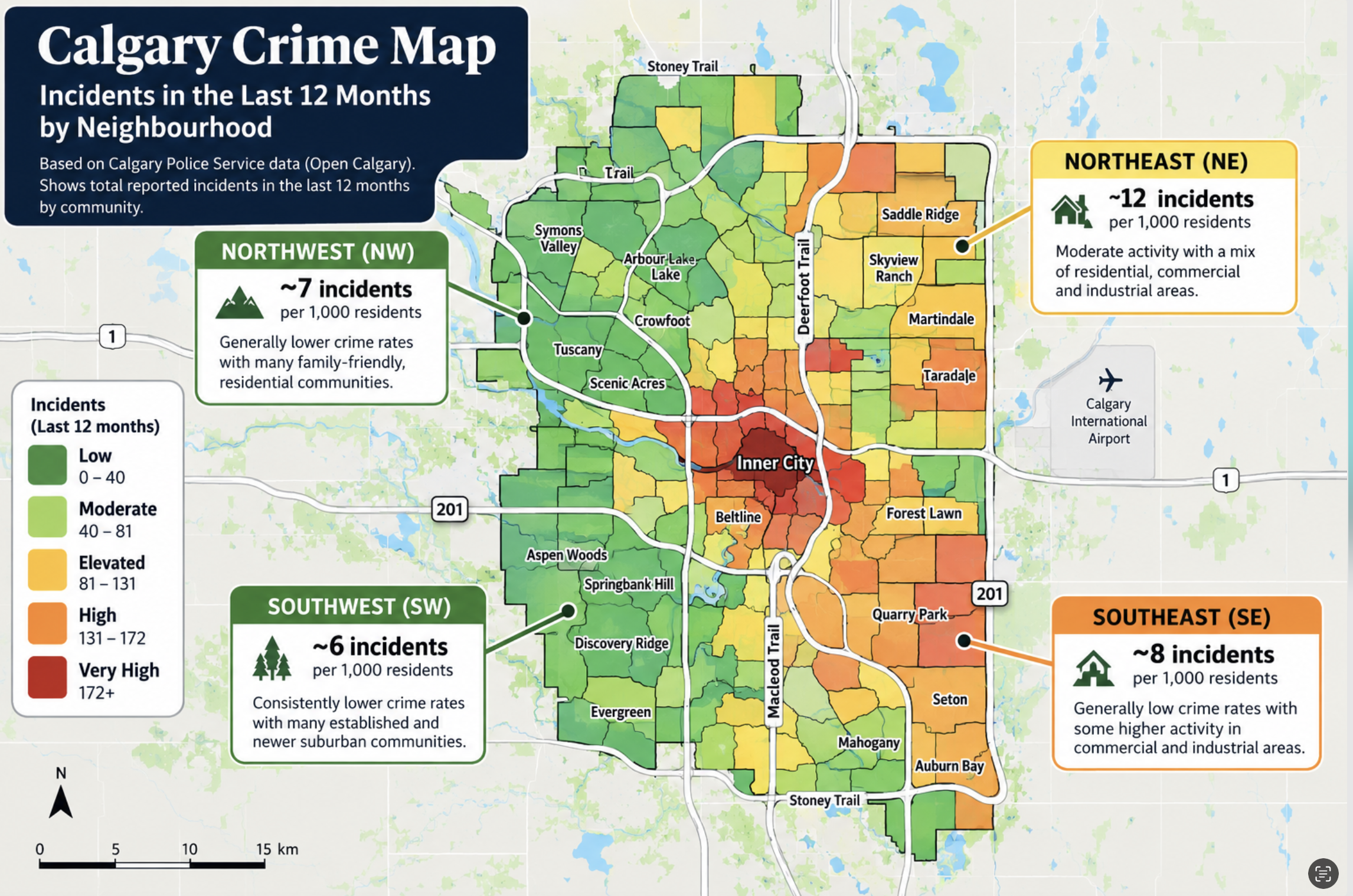
A published 2026 community safety analysis identified the following approximate crime-rate patterns.
|
Calgary Area |
Approximate Reported Crime Rate |
|---|---|
|
Southwest Calgary |
6 incidents per 1,000 residents |
|
Northwest Calgary |
7 incidents per 1,000 residents |
|
Southeast Calgary |
8 incidents per 1,000 residents |
|
Northeast Calgary |
12 incidents per 1,000 residents |
|
Inner-City Calgary |
45+ incidents per 1,000 residents |
Source: Published 2026 Calgary neighbourhood safety analysis. These are secondary-source estimates rather than independently verified official quadrant-wide rates. Reporting periods, geographic boundaries, and crime categories may differ, so the figures should be treated as general context rather than definitive rankings.
At first glance, southwest and northwest Calgary appear to have comparatively low reported crime rates. However, the differences between quadrants deserve some additional explanation.
Southwest Calgary: Established Communities and Residential Suburbs
Southwest Calgary contains some of the city’s most established residential neighbourhoods, along with newer developments along the western and southern edges of the city.
Communities such as Aspen Woods, Discovery Ridge, Springbank Hill, West Springs, and Evergreen offer a variety of detached homes, townhomes, condominiums, and executive properties.
Many of these communities are primarily residential, with shopping centres and commercial activities concentrated in designated areas. This can influence the number and type of police-reported incidents.
Southwest Calgary also includes busy inner-city communities such as the Beltline, Mission, and parts of the downtown core.
These areas have substantially different land uses, population densities, and activity patterns than suburban neighbourhoods. For this reason, buyers should avoid assuming that every southwest community has similar crime statistics.
Northwest Calgary: Family-Oriented Communities and Established Neighbourhoods
Northwest Calgary offers a mixture of established neighbourhoods, newer suburban developments, and communities with convenient access to parks and recreational amenities.
Popular residential areas include Tuscany, Royal Oak, Rocky Ridge, Arbour Lake, Panorama Hills, and Scenic Acres.
Many northwest communities feature schools, playgrounds, pathways, and residential streets designed around local neighbourhood traffic. However, northwest Calgary also contains major commercial areas, transit connections, and higher-density residential developments.
As with any quadrant, individual community statistics provide a more useful comparison than broad geographic averages.
Southeast Calgary: Newer Communities and Established Residential Areas
Southeast Calgary includes some of the city’s fastest-developing residential areas. Communities such as Mahogany, Auburn Bay, Cranston, Chaparral, Legacy, and Seton offer a broad selection of housing types. Several of these communities feature extensive pathway systems, parks, recreational facilities, and neighbourhood amenities.
Mahogany and Auburn Bay are particularly well known for their lake communities, while Cranston provides access to the Bow River corridor and nearby natural areas. Southeast Calgary also contains industrial districts, major commercial corridors, and established inner-city neighbourhoods.
Consequently, crime patterns can differ significantly depending on the specific community being researched.
Northeast Calgary: Diverse Housing and Growing Communities
Northeast Calgary offers a wide selection of residential neighbourhoods, including both established communities and newer developments. Areas such as Coventry Hills, Skyview Ranch, Redstone, Cornerstone, Cityscape, and Saddle Ridge provide different housing options and community amenities. The northeast also contains major transportation infrastructure, commercial centres, industrial areas, and Calgary International Airport.
These different land uses can influence reported incident totals.
Importantly, a higher quadrant-wide crime rate does not mean every neighbourhood within that quadrant experiences elevated crime.
Many northeast communities have predominantly residential streets and neighbourhood amenities similar to those found throughout Calgary. For prospective buyers, examining the actual community-level statistics is much more informative than making assumptions based on a quadrant alone.
Which Calgary Neighbourhoods Have Lower Reported Crime Rates?
When researching Calgary’s safest neighbourhoods, it’s helpful to look beyond broad quadrant comparisons. Several established suburban communities are frequently discussed in local safety analyses because of their predominantly residential environments. The following communities are worth researching for buyers who prioritize quieter residential settings.
These are examples of communities to investigate, not a verified ranking of Calgary’s ten safest neighbourhoods.
Discovery Ridge
Located along Calgary’s western edge, Discovery Ridge is known for its proximity to Griffith Woods Park and its extensive natural surroundings. The community features detached homes, townhomes, and condominium developments. Its residential character and access to parks make it an option for buyers who value outdoor recreation and a quieter neighbourhood environment.
Aspen Woods
Aspen Woods is an established west Calgary community featuring executive homes, newer residential developments, and convenient access to schools and shopping. The neighbourhood offers a mixture of housing options, including luxury detached properties and townhomes. Buyers interested in Aspen Woods should review current community crime statistics alongside property values and housing inventory.
Tuscany
Tuscany is a large northwest Calgary community known for its residential developments, recreational amenities, and access to natural spaces. The neighbourhood features a variety of detached homes, townhomes, and other residential properties. Its location also provides access to major transportation routes and the Tuscany CTrain station. Because Tuscany is a substantial community, buyers may find it useful to explore different sections rather than relying exclusively on a neighbourhood-wide average.
Arbour Lake
Arbour Lake is northwest Calgary’s established lake community. Residents have access to community lake amenities, while the surrounding area offers shopping, schools, recreational facilities, and transportation connections. The neighbourhood includes a mixture of detached homes, townhomes, and condominium developments. Its combination of residential amenities and established infrastructure makes it a community worth considering during a northwest Calgary home search.
Mahogany
Mahogany is one of southeast Calgary’s prominent master-planned lake communities. The neighbourhood features two private beaches, extensive pathways, parks, and a growing collection of commercial amenities. Housing options range from condominiums and townhomes to detached residences and estate properties. For buyers considering Mahogany, reviewing current crime statistics alongside housing prices and community amenities can help provide a more complete picture.
Chaparral
Chaparral is an established southeast Calgary community offering detached homes, townhomes, and lake-oriented residential amenities. The neighbourhood is located near Fish Creek Provincial Park and provides convenient access to several major transportation routes. Chaparral’s residential environment makes it another community worth researching for buyers interested in southeast Calgary.
Parkland
Parkland is an established southeast Calgary neighbourhood bordering Fish Creek Provincial Park. Known for its mature landscaping, residential streets, and access to natural areas, Parkland offers a different housing environment from Calgary’s newer suburban developments. The community primarily features established detached homes. For buyers seeking an older residential neighbourhood with access to extensive parkland, Parkland may be worth exploring.
Understanding Calgary’s Crime Map: What the Numbers Actually Mean
When researching neighbourhood safety, one of the biggest mistakes is comparing crime totals without considering population. For example, imagine two hypothetical Calgary communities.
Community A records 150 reported incidents during a year and has 20,000 residents.
Community B records 75 reported incidents but has only 5,000 residents.
Although Community B reports half as many incidents, its crime rate relative to population is actually higher.
The calculations would be:
|
Community |
Reported Incidents |
Population |
Incidents per 1,000 Residents |
|---|---|---|---|
|
Community A |
150 |
20,000 |
7.5 |
|
Community B |
75 |
5,000 |
15.0 |
Illustrative example only.
This is why crime rates per 1,000 residents are often more useful than total incident counts when comparing communities. However, even population-adjusted rates have limitations.
A neighbourhood containing major shopping centres or entertainment destinations may experience considerable activity from people who do not actually live there. These visitors can contribute to reported incidents without being included in the neighbourhood’s residential population.
Similarly, a small community may experience a noticeable change in its calculated crime rate following only a handful of incidents. Understanding these differences helps prevent misleading comparisons.
Property Crime vs. Violent Crime: Why the Type of Incident Matters
Not all police-reported incidents are the same. When researching Calgary neighbourhoods, buyers should consider the types of incidents being reported rather than focusing exclusively on the total number.
Property Crime
Property crime can include offences such as theft, vehicle-related theft, and break-ins. These incidents may be influenced by parking arrangements, commercial activity, and other neighbourhood characteristics.
Violent Crime
Violent offences involve a different set of circumstances and should be examined separately from property-related incidents. A neighbourhood with a relatively high number of vehicle-related thefts does not necessarily have a correspondingly high rate of violent crime.
Crime Trends Over Time
Another important consideration is whether reported incidents are increasing, decreasing, or remaining relatively stable. A single year’s statistics may not accurately represent a neighbourhood’s longer-term experience. For example, a community that experienced an unusually high number of incidents during one year may subsequently return to its previous pattern. Looking at several years of information can provide additional context.
Calgary Crime Trends From 2017 to 2026
One useful resource for researching longer-term neighbourhood trends is the YYC-Wander Calgary Community Crime Dashboard.
The platform allows users to explore community crime information across a historical period extending from 2017 to 2026. Its interactive features include community comparisons, crime categories, population-adjusted rates, and historical trends.
For example, a dashboard snapshot covering July 2025 through June 2026 for Calgary’s west sector displayed:
- 1,698 reported crime cases.
- 25 communities with selected crime records.
- A highest displayed community rate of 38.99 cases per 1,000 residents in Lincoln Park.
- Theft from vehicles as the most frequently reported category, accounting for 482 cases.
These figures apply specifically to the dashboard’s selected west-sector communities, reporting period, and crime filters. They should not be interpreted as Calgary-wide totals. The example also illustrates why understanding the type of incident matters.
Vehicle-related property crime may account for a substantial portion of reported activity in some areas. For prospective homebuyers, examining these categories individually can be more useful than relying on a single overall crime statistic.
Why Do Some Inner-City Calgary Communities Report Higher Crime Rates?
Calgary’s inner-city neighbourhoods often have different crime patterns from predominantly residential suburbs.
This is partly because downtown and surrounding communities serve a much larger population than their permanent residential totals suggest. Every day, people travel into central Calgary for employment, shopping, entertainment, education, and other activities.
Neighbourhoods containing restaurants, bars, retail stores, transit stations, and major commercial developments can experience considerably more pedestrian and vehicle activity than residential suburbs.
This additional activity may contribute to higher reported incident totals. It also affects how crime rates per 1,000 residents should be interpreted.
For example, a neighbourhood with a relatively small permanent population but thousands of daily visitors may report a higher population-adjusted incident rate.
That doesn’t necessarily mean every residential street within the community experiences the same level of activity. For buyers interested in inner-city Calgary, it can be particularly helpful to research the immediate area surrounding a property rather than relying entirely on community-wide statistics.
How to Research Calgary Neighbourhood Crime Statistics Before Buying
If you’re considering purchasing a home in Calgary, several publicly available resources can help you evaluate community safety.
1. Calgary Police Service Crime Statistics
The Calgary Police Service publishes crime information and community-level reporting resources. These provide an official starting point for understanding police-reported incidents and local crime trends. When reviewing the data, pay attention to the reporting period and the categories included.
2. Calgary Community Crime Dashboard
The YYC-Wander dashboard provides an interactive way to compare Calgary neighbourhoods. Users can examine community crime rates, historical trends, and different offence categories. Its population-adjusted measurements can be particularly helpful when comparing communities of different sizes.
3. Calgary Crime Intelligence Map
Another available resource is the Calgary Crime Intelligence Map, which uses official Open Calgary datasets. The map displays reported incidents by community using colour-coded categories.
In its last-12-months count view, the map groups communities into the following incident ranges:
|
Map Category |
Reported Incidents |
|---|---|
|
Low |
0–40 |
|
Moderate |
40–81 |
|
Elevated |
81–131 |
|
High |
131–172 |
|
Very High |
172+ |
These categories represent total reported incidents, not incidents per 1,000 residents.
As a result, they should not be used on their own to determine which communities have the highest or lowest crime rates.
4. Visit the Neighbourhood
Crime statistics are useful, but they cannot tell you everything about living in a particular community.
If possible, spend time exploring the neighbourhood at different times of day.
Pay attention to transportation routes, pedestrian activity, nearby commercial developments, and the general residential environment. Visiting a community can help you determine whether its location and amenities align with your preferences.
Does a Lower Crime Rate Mean a Better Neighbourhood?
Not necessarily.
Although safety is an important consideration, it represents only one aspect of choosing where to live.
A neighbourhood with a lower reported crime rate may be farther from employment centres, have fewer public transportation options, or offer a different selection of housing types.
Conversely, a centrally located community may experience higher reported incident totals while providing convenient access to employment, restaurants, entertainment, and urban amenities.
Different buyers prioritize different characteristics.
For some, a quiet residential street and access to parks may be the most important considerations.
Others may prefer a walkable inner-city neighbourhood with convenient transit connections and a shorter commute.
Ultimately, the right neighbourhood depends on your individual housing requirements, budget, and lifestyle preferences.
Frequently Asked Questions About Calgary Neighbourhood Safety
What are the safest neighbourhoods in Calgary?
There is no single definitive ranking that applies across every crime category and reporting period.
Communities such as Discovery Ridge, Aspen Woods, Tuscany, Arbour Lake, Mahogany, Chaparral, and Parkland are examples of residential areas worth researching.
However, buyers should consult current Calgary Police Service statistics before drawing conclusions about which neighbourhoods have the lowest reported crime rates.
Is northwest Calgary safer than northeast Calgary?
Some published neighbourhood safety comparisons suggest northwest Calgary has lower overall reported crime rates than northeast Calgary.
However, these are broad geographic averages.
Individual communities within either quadrant can have very different crime patterns, making neighbourhood-level comparisons more useful.
Is southwest Calgary a safe place to live?
Southwest Calgary contains many established residential neighbourhoods and newer suburban developments.
It also includes busy commercial districts and inner-city areas.
Because the quadrant is geographically and economically diverse, safety statistics should be reviewed at the individual community level.
Are newer Calgary communities safer than older neighbourhoods?
Not necessarily.
Newer residential communities may have fewer commercial destinations or different traffic patterns, but their age alone does not determine safety.
Established communities can also report relatively low crime rates.
Population size, land use, reporting periods, and the types of incidents recorded all influence neighbourhood statistics.
Where can I find Calgary crime rates by neighbourhood?
The Calgary Police Service and Open Calgary provide official crime-related information.
Interactive tools such as YYC-Wander and Calgary Crime Intelligence can also help residents explore community-level statistics.
How often should I check Calgary crime statistics?
For anyone actively considering purchasing a home, reviewing the most recent available statistics is a good starting point.
It can also be helpful to compare multiple years to identify whether reported incidents are increasing, decreasing, or remaining relatively stable.
Final Thoughts: Choosing the Right Calgary Neighbourhood
Calgary offers a wide range of residential communities, each with its own housing options, amenities, and neighbourhood characteristics.
While available crime statistics suggest that many of Calgary’s suburban communities experience relatively low reported incident rates, no single map or ranking can fully describe the experience of living in a particular area.
For buyers relocating to Calgary or moving within the city, the most useful approach is to combine current crime statistics with housing market information, neighbourhood research, and personal visits.
Understanding the difference between total incidents, population-adjusted crime rates, and crime severity can help you interpret the information more accurately.
Most importantly, neighbourhood safety should be considered alongside affordability, transportation, schools, recreational amenities, and your long-term housing goals.
Thinking About Buying a Home in Calgary?
Whether you’re relocating to Calgary, purchasing your first home, or considering a move to a different community, understanding the local housing market is an important part of the process.
I’ve been helping buyers and sellers navigate Calgary real estate since 2016, working with residential properties, acreages, and investment properties throughout Calgary and the surrounding communities.
If you’re exploring different neighbourhoods, I can help you compare available homes, understand local market conditions, and find properties that align with your needs.
Explore Calgary homes for sale, browse our Calgary Community Guide, or contact me directly to discuss your next move.
Viktor Boraczuk
REALTOR® | REAL Broker
Calgary House Guide
CalgaryHouseGuide.com
Disclaimer: Crime statistics are historical measures of police-reported incidents and do not predict future events or guarantee personal safety. Community-level comparisons may be affected by population size, land use, reporting practices, and the time period examined. Buyers should consult the latest official Calgary Police Service information when researching individual neighbourhoods.

